
South Node
Volume III · Planets & Points
Foundations
-
10-12 minutes
The South Node represents familiar patterns, natural strengths, and ways of being that come easily to us. It reflects what we already know, where we often seek comfort, and the gifts we carry with us as we move toward growth and evolution.
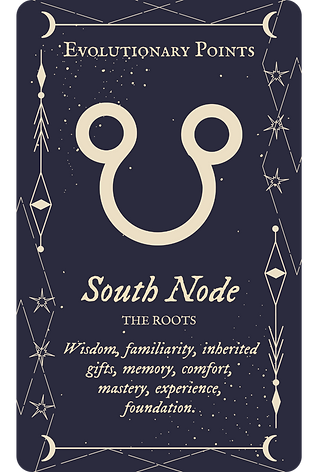
If the North Node points toward where we are growing, the South Node reveals where we have been.
The South Node represents familiarity.
It describes qualities, habits, strengths, and patterns that feel natural and instinctive.
These are the places we often return to when life feels uncertain because they are well known to us.
Unlike the planets, the South Node is not a physical body in the sky.
It is the point directly opposite the North Node, forming a symbolic axis that tells a story about balance, growth, and development.
Because the South Node is associated with the past, it is sometimes described as what we are meant to leave behind.
This interpretation can be misleading.
The South Node is not a mistake.
It is not a weakness.
It is not something that needs to be discarded.
In many ways, the South Node represents some of our greatest strengths.
These qualities often feel effortless because we have practiced them for a very long time.
We know how to rely on them.
We trust them.
We understand them.
The challenge is not that the South Node is wrong.
The challenge is that it can become overly comfortable.
Imagine a well-worn path through a field.
You have walked it so many times that you no longer need to think about where it leads.
The route is familiar.
Predictable.
Safe.
The South Node often functions in a similar way.
When we feel uncertain, stressed, or afraid, we tend to return to familiar patterns.
Even when those patterns no longer support our growth.
This is where the relationship between the South Node and North Node becomes important.
The South Node provides the foundation.
The North Node provides the direction.
One offers wisdom and experience.
The other offers possibility and growth.
Healthy development requires both.
Without the South Node, we lack roots.
Without the North Node, we stop growing.
The goal is not to abandon the South Node.
It is to use its gifts in service of the North Node.
To bring what we already know into the experiences we are learning to embrace.
This relationship can be seen throughout life.
Many people discover that their greatest strengths can also become limitations when relied upon too heavily.
The skills that once protected us may eventually constrain us.
The qualities that once brought success may eventually require adaptation.
Growth often begins when we recognize that our familiar ways of operating are no longer enough on their own.
Like every astrological symbol, the South Node contains both gifts and challenges.
Its gifts include wisdom, competence, experience, natural talents, and well-developed abilities.
Its challenges may appear as stagnation, resistance to change, overreliance on familiar strengths, or difficulty embracing new experiences.
Every chart contains a South Node.
Every person carries gifts from the past.
Understanding the South Node helps us recognize those gifts while remaining open to the growth that awaits beyond them.

Reflections
What familiar strengths am I being asked to build upon rather than remain within?
Think about qualities or abilities that come naturally to you.
How have they supported your life?
Are there ways they may also be keeping you from exploring new possibilities?
Bring It Into Your Life
Choose one strength you naturally rely upon.
This week, ask yourself how that strength might support a new challenge rather than simply maintaining what already exists.
Use the familiar as a bridge to the unfamiliar.
Carry This Forward

The South Node represents the gifts, strengths, and familiar patterns we already know, providing the foundation from which meaningful growth can occur.


Continue Exploring

Title