
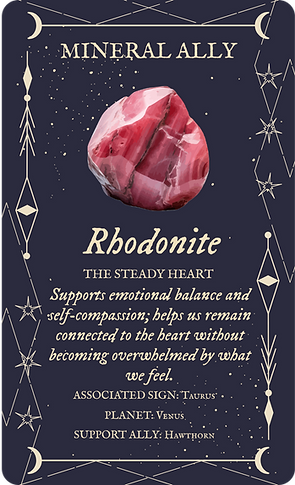
Rhodonite
The Mending Heart
Rhodonite is often associated with emotional healing, forgiveness, and compassion, but its medicine does not ask us to smooth over what has hurt. It belongs to the slower work that comes after rupture: acknowledging what happened, tending what remains tender, and discovering whether connection can exist without self-abandonment. Rhodonite brings softness together with structure. It reminds us that compassion and boundaries are not opposites and that repair does not necessarily mean returning things to the way they were. Sometimes repair means building a different relationship with ourselves, with another person, or with what has happened.
ALLY TYPE
Mineral Ally
ASSOCIATED SIGNS
Taurus, Libra, Scorpio
PLANETARY
Venus
ELEMENT
Earth Element, Water Element
ENERGETIC SIGNATURE
Boundaries, Compassion, Emotional Healing, Forgiveness, Integration, Reconciliation, Repair, Resilience, Self-Respect, Stability
BODY RESONANCE
Boundaries, Chest, Emotional Regulation, Grounding, Heart, Nervous System, Safety, Self-Protection, Stability, Tenderness
SOMATIC ACTIONS
Encourages steadiness when strong emotions make it difficult to remain present
Supports compassionate contact with tender places without demanding immediate resolution
Helps reconnect emotional openness with boundaries and self-protection
Encourages awareness of what is needed after conflict, disappointment, or rupture
Supports gradual movement from emotional reactivity toward grounded response
ENERGETIC SIGNATURE
Rhodonite carries an energy of compassionate repair. Unlike Rose Quartz, whose movement centers on tenderness and receiving, Rhodonite enters the places where love has encountered difficulty. It asks how care might continue without denying anger, disappointment, grief, or necessary boundaries. Its work is restorative rather than restorative in the sense of returning to the past; it supports the creation of something more honest from what has been learned.
BODY RESONANCE
Rhodonite can accompany moments when emotion is present but complete withdrawal does not feel like the answer. After conflict, disappointment, grief, or relational strain, the body may alternate between reaching toward connection and pulling away for protection. Rhodonite offers a symbolic middle ground. Its invitation is to notice what allows tenderness and self-protection to coexist. Rather than rushing toward reconciliation or closure, it supports enough steadiness to remain in relationship with your own experience while deciding what comes next.
The Lore
Rhodonite is a manganese-rich mineral recognized by its characteristic pink to rose-red coloring, often crossed with dark manganese oxide veining. Its name comes from the Greek rhodon, meaning “rose.” Significant deposits have historically been found in Russia, where Rhodonite became an important ornamental stone and was used for decorative objects, architectural details, and large carved works. Its striking combination of soft pink and dark veining has contributed to its contemporary symbolism: tenderness held alongside strength, emotional openness alongside grounding, and love that does not require the absence of difficulty.
PREPARATION & USE
Keep Rhodonite somewhere associated with reflection, relationships, or emotional decompression. Hold it after a difficult interaction before deciding what needs to happen next, allowing the first task to be noticing your own response. It can accompany journaling about boundaries, forgiveness, grief, conflict, or relational patterns. Rather than asking whether you should forgive or reconnect, begin with the more immediate question of what would help you remain connected to yourself.
RITUALS & PREPARATIONS
Rhodonite is particularly suited to Waning and Dark Moon practices. During the Waning Moon, it can accompany the release of resentment, old relational roles, or patterns of self-abandonment without requiring premature forgiveness. During the Dark Moon, it supports quieter forms of repair and integration—the work that occurs when nothing needs to be fixed publicly or immediately. It can also accompany boundary rituals, relationship transitions, grief work, reconciliation, and practices centered on reclaiming self-respect after rupture.
JOURNAL PROMPT
What would repair look like if it did not require me to abandon myself?


